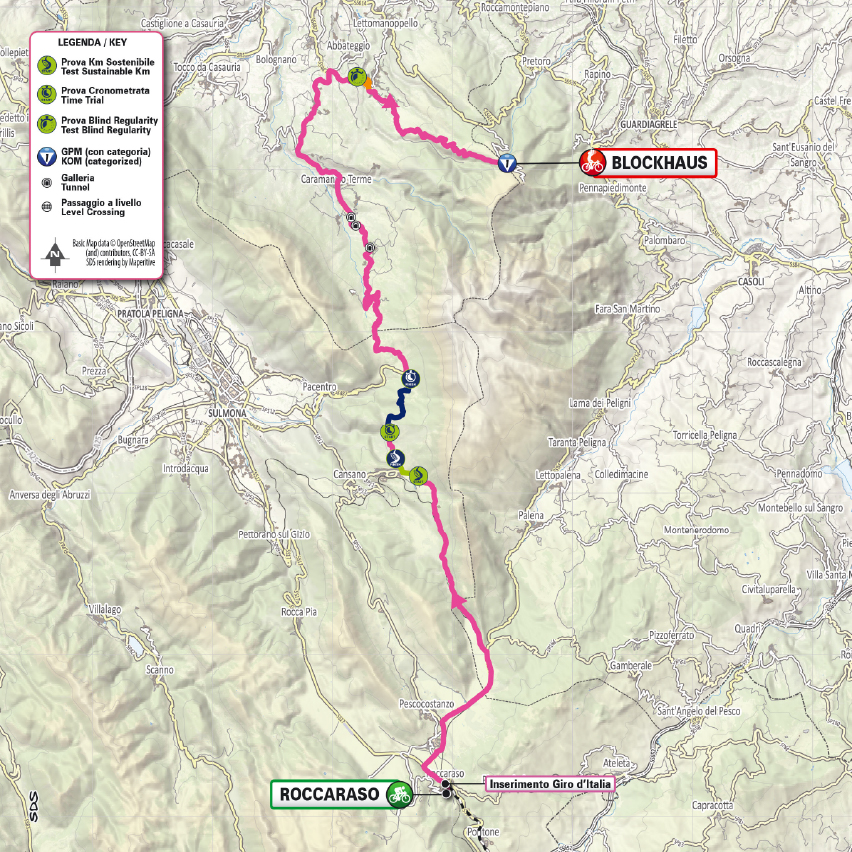
profile
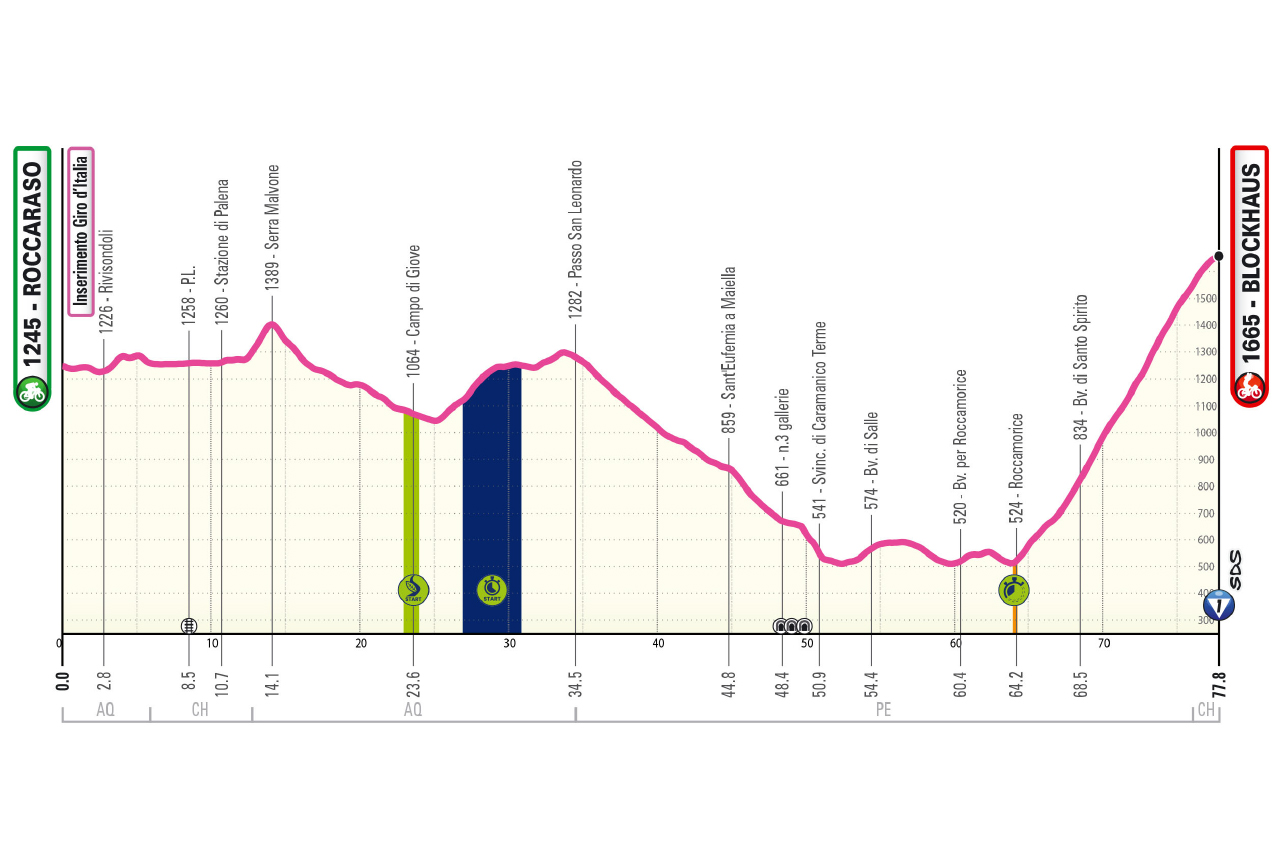
map
itinerary timetable
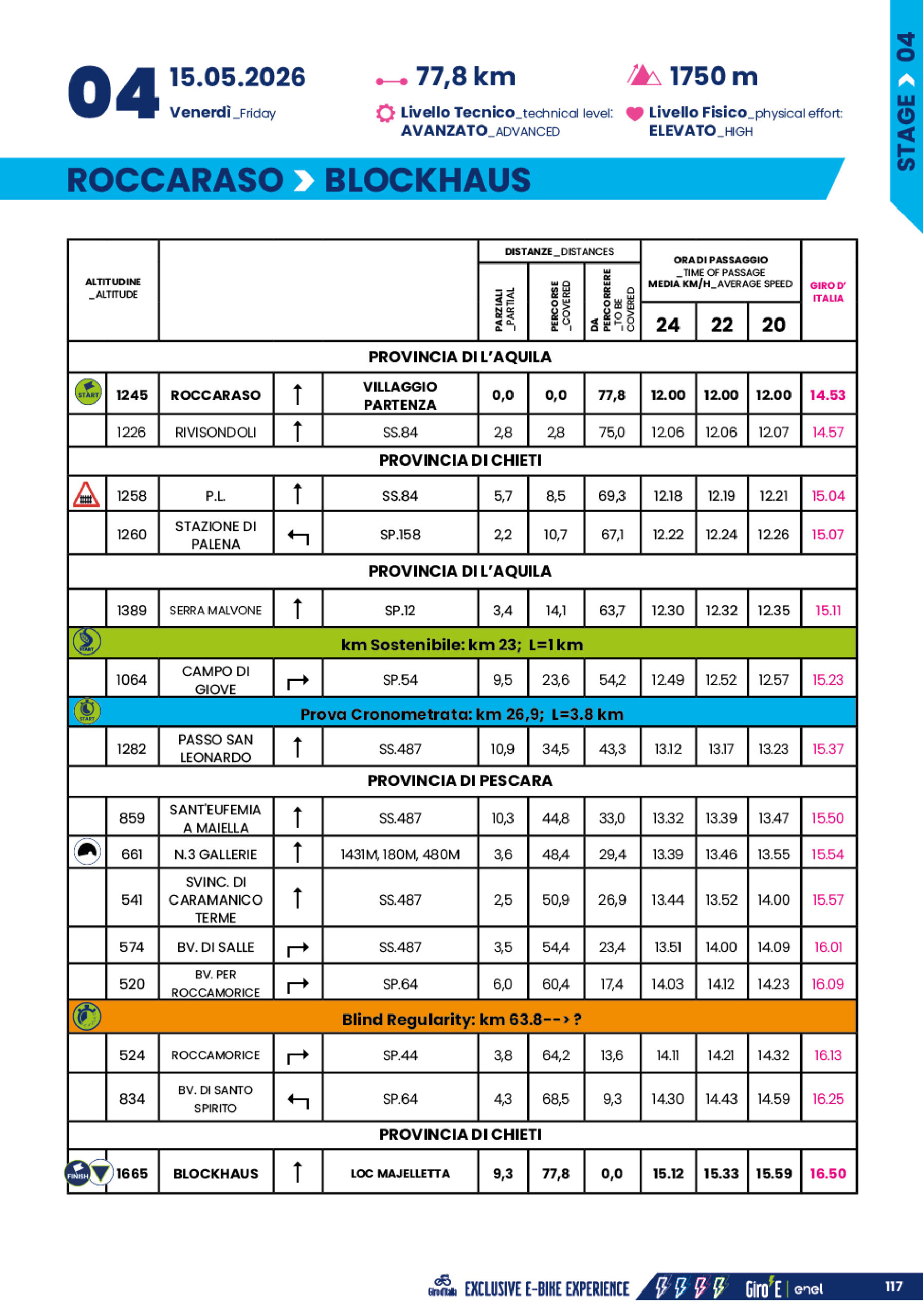

Friday 15
May 2026
77,8 km
Altitude gain 1750 mt
Technical Level: Advanced
Physical Effort: High
 Starting in
Host city:
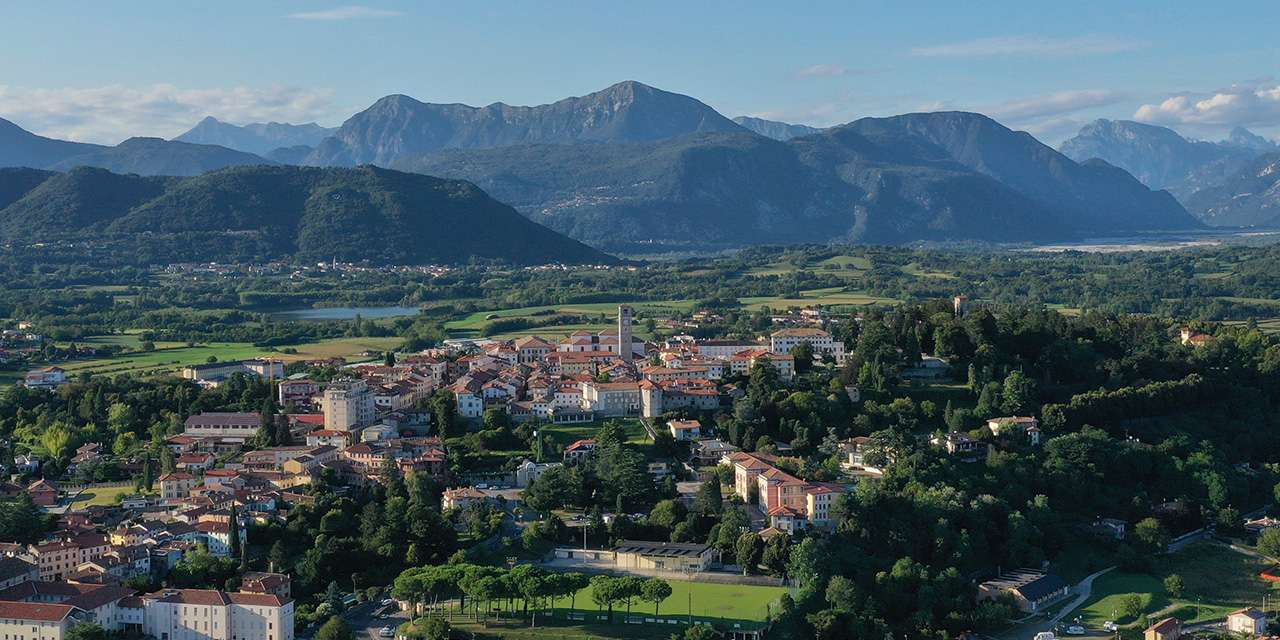
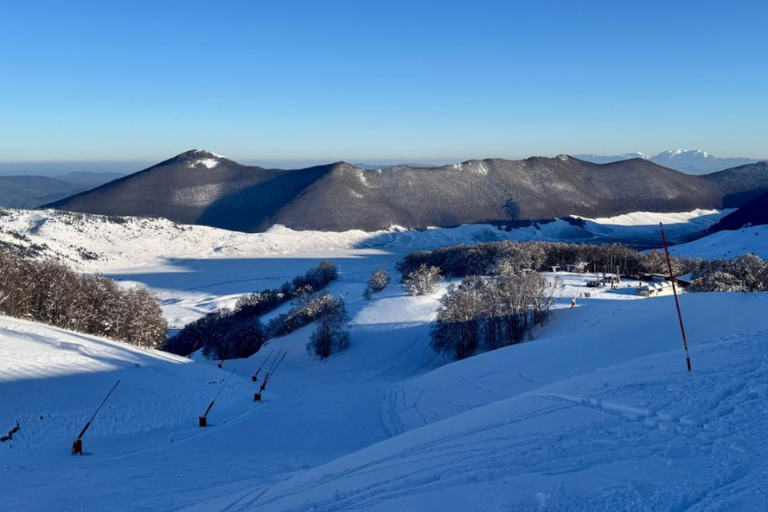
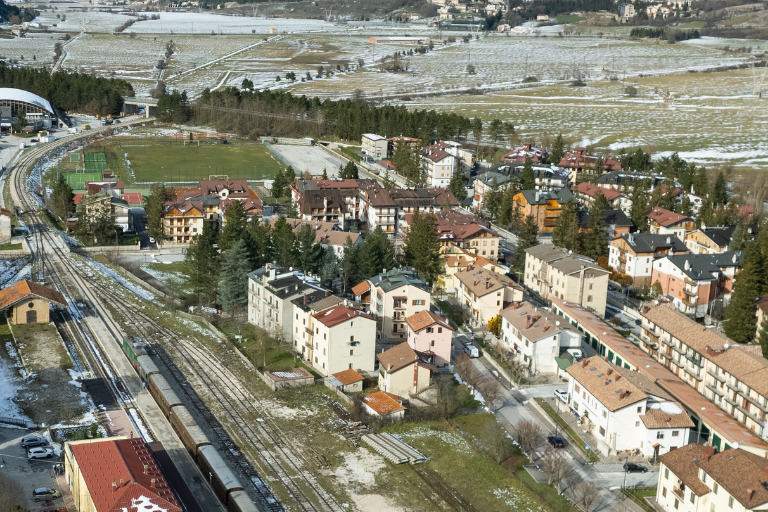
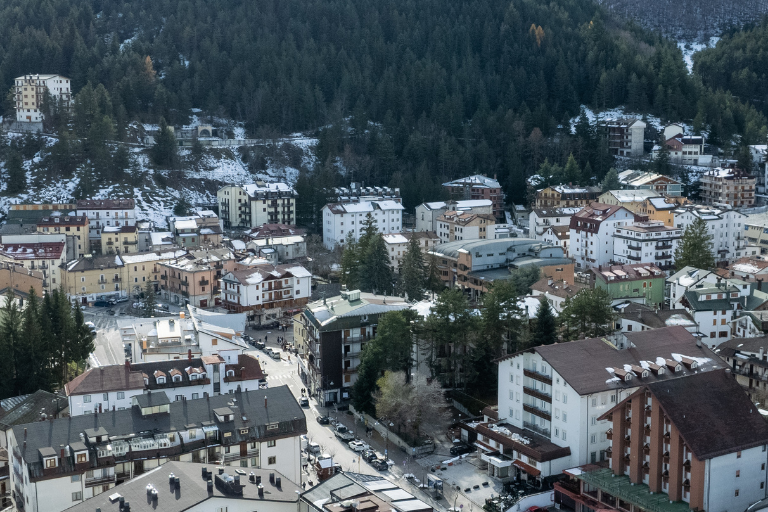
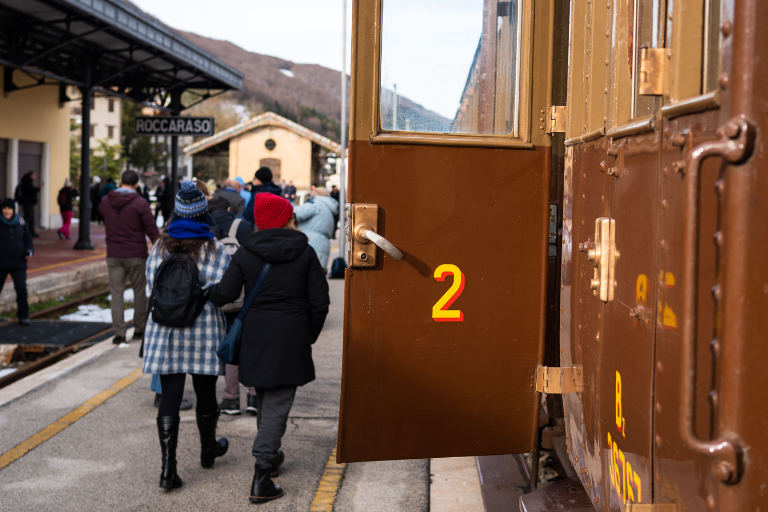
Roccaraso is an Italian town of 1,493 inhabitants in the province of L’Aquila, in Abruzzo. Located on the southern edges of the Cinquemiglia plateau, it was part of the Cinquemiglia plateau and the Alto Sangro mountain community until the latter’s dissolution in 2013. Its ski facilities, belonging to the Alto Sangro ski area, make the resort one of the major mountain tourist destinations in the entire Apennines.
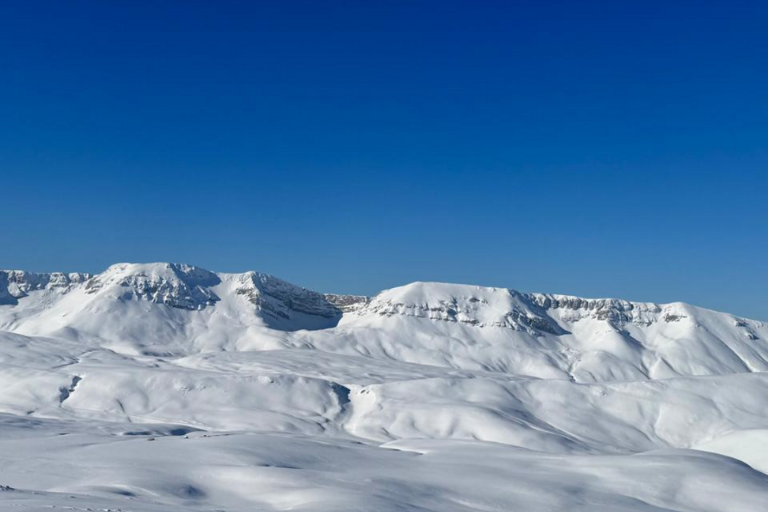
Roccaraso is situated in the lower province of L’Aquila, within the area of the major plateaus of Abruzzo; it is located south of the Cinquemiglia and Quarto Grande plateaus and is overlooked to the west by the Aremogna plain and the Roccaraso mountains (a subgroup of Monte Greco). The town center is located at 1,236 meters above sea level.
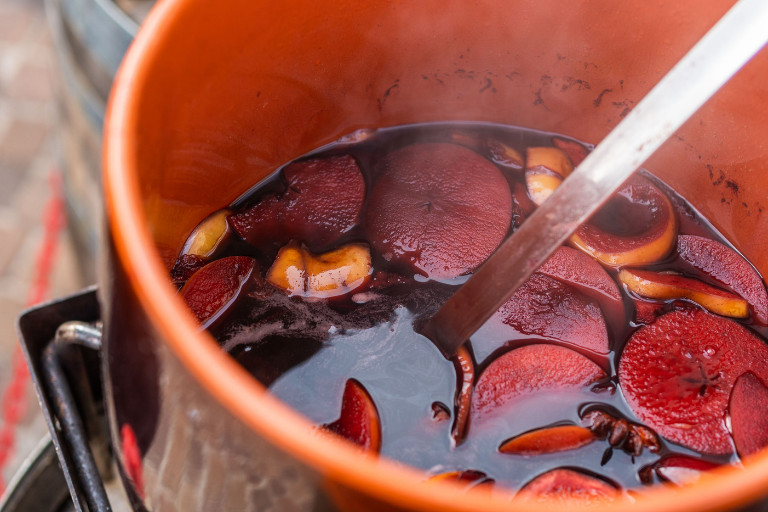
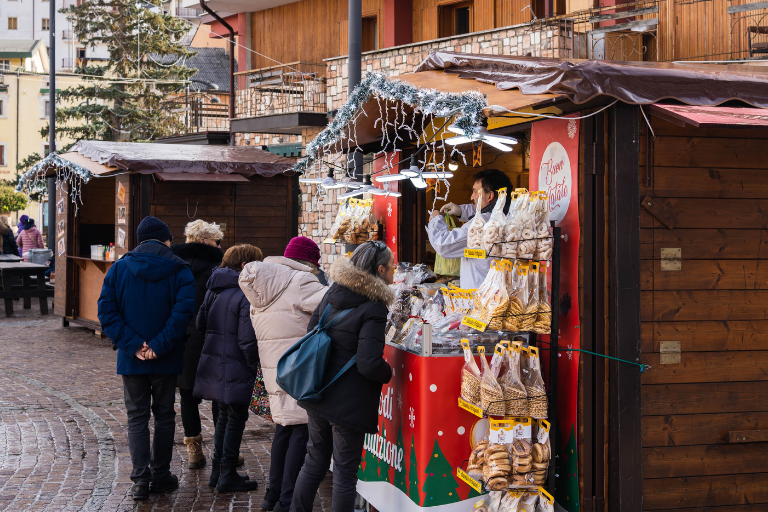
Local gastronomy is characterized by the high altitude and the area’s pastoral origins. In fact, the elevation does not allow for common vegetable crops. Small local producers grow tubers, potatoes, wheat, and barley primarily for livestock fodder.
Cattle, sheep, and pig farming provide high-quality products, with particular emphasis on pork for cured meats and milk for its derivatives. In spring, these products take on particularly intense characteristics as livestock graze freely across vast, pristine green expanses.
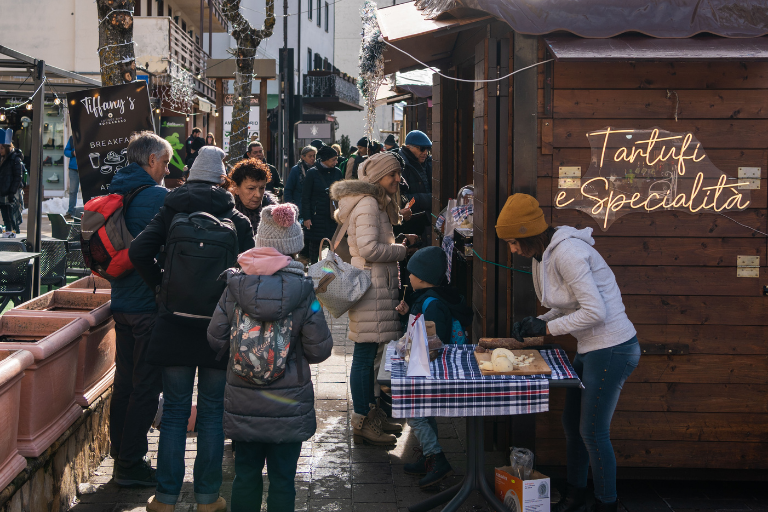
The local dining scene offers a wide selection of dishes ranging from tradition to modernity, featuring specialties such as Pancotto, Cazzarielli e Foglie, Cazzarielli e Fagioli, Sausage and Scamorza, and Pecora al Cutturo. Local restaurateurs enhance these raw materials and traditional methods to achieve a bold and intense flavor. These signature dishes highlight the historical importance of transhumance and the need to quickly process the few available ingredients. The gastronomy is the result of a humble and minimalist peasant tradition.
Pancotto is a typical dish of the transhumance, made with wild field greens, eggs, and stale bread.
Cazzarielli e foglie is a humble soup or stew made with a fresh pasta—a water and flour dough similar to a small gnocchi—served with “leaves” (savoy cabbage) and enriched with animal fats such as pork scraps, pancetta, or guanciale.
Salsiccia e scamorza features classic local pork sausage, seasoned exclusively with salt and pepper, paired with scamorza, a semi-hard cheese particularly suitable for cooking.
Pecora al cutturo is prepared using adult sheep meat simmered over low heat for several hours. Traditionally, it was cooked in a large pot over embers; today, it is prepared for diners within professional kitchens.
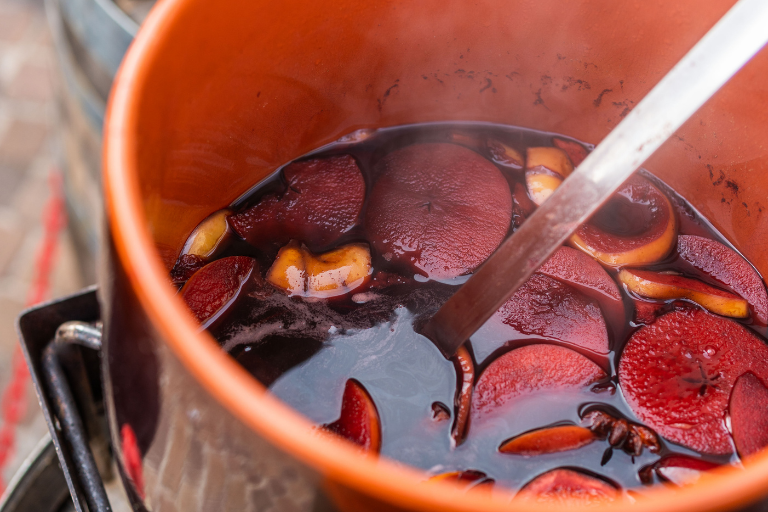
The typical liqueur is Genziana. It is made from a specific and protected species of shrub root which, through an infusion process, produces a bitter with excellent digestive properties.
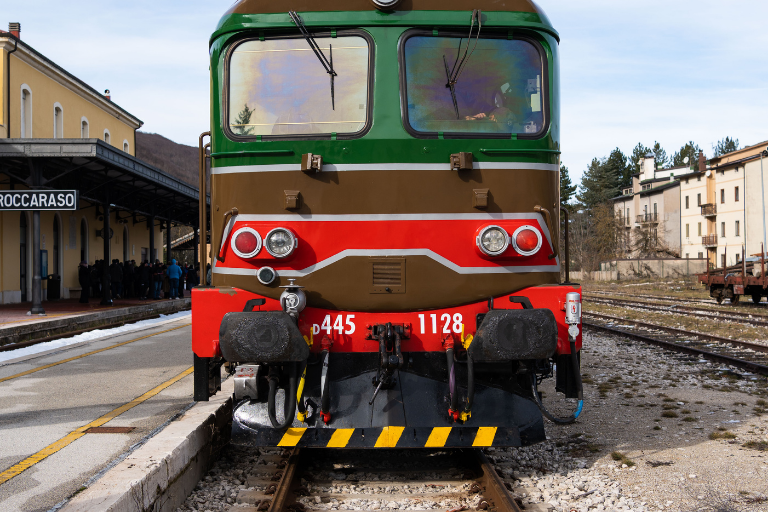
Until 1943, Roccaraso appeared as a medieval village perched on an escarpment, consisting of rough stone houses huddled together. The style of the dwellings in ashlar stone, with lintelled windows, was very similar to that of the nearby villages of Pescocostanzo, Castel di Sangro, and Campo di Giove: the **civitella** (citadel) constituted the highest point, enclosed between Piazza XX Settembre, Via Bonaventura Trilli, Via Aracoeli, Via Salvatore Tommasi, and Via del Sannio—an area completely transformed today due to wartime destruction, now occupied by new houses and hotels. The village was accessed through the gate of the **Torrione dell’orologio civico** (Civic Clock Tower); the 19th-century outskirts, featuring tourist houses and hotels, began at the Church of Sant’Ippolito (now Santa Maria Assunta) and continued along the entire Via Roma.
After World War II, the center was almost completely destroyed, losing its historical **Torretta del Castello** (Castle Tower), which overlooked Piazza XX Settembre in front of the churchyard of Sant’Ippolito. Historical photos show its irregular rectangular plan with crenelated battlements, used since the 1800s as a clock tower. It stood opposite the Church of the Assunta, where a hotel is located today. In terms of historical and artistic interest, modern-day Roccaraso has very little remaining, except for the medieval village of Pietransieri and the Baroque Church of San Rocco. Atop Mount Zurrone, in memory of the battle against the Germans, stands the **Monumento ai Caduti senza Croce** (Monument to the Fallen without a Cross), made of concrete with two buttresses that, forming an isosceles triangle, support a chapel with a tall central Latin cross.
Parish Church of Santa Maria Assunta
The parish church of Santa Maria Assunta is located in front of the **Rocca di Roccaraso** (the ancient Castle Tower), used in the 19th century as a clock tower, currently at Via Caracciolo, 3. It dates back to before the 16th century and was remodeled in the early 17th century.
The interior features three naves with stone columns interspersed with round arches. Records from 1588 show that the church, dedicated to Sant’Ippolito, consisted of 9 altars; by 1630, it had 15, though some were later demolished. Today, 11 remain. The 16th-century wooden pulpit is attached to one of the main nave columns and is similar to the one in the collegiate church of Pescocostanzo. The wooden baptismal font was divided into two parts.
The earthquakes of 1703 (L’Aquila earthquake) and 1706 (Maiella earthquake) damaged it repeatedly until World War II destroyed it completely. It was entirely rebuilt in 1954 and inaugurated in 1957.
From the original church, only the silver statue of Sant’Ippolito remains—the patron saint of Roccaraso, a product of the Neapolitan school of goldsmithing, donated by Baron Donato Berardino Angeloni in 1688. The statue escaped looting during World War II because it was kept hidden. Before the war, the church had a late Baroque appearance: the exterior was plastered, with a facade decorated by a triangular pediment lintel, divided vertically by pilasters into three sections, with the central one featuring a window with a broken pediment and a Sulmona-style lintelled portal. The bell tower was a stocky tower, and the three-nave interior was richly decorated with stucco, pendentives, and side altars with paintings.
Today’s design only partially respects the ancient appearance: it has a rectangular layout with a semicircular apse and a gabled facade in ashlar stone, featuring an entrance narthex with three arches leading to the main portal. The facade ends in a triangular pediment with a central oculus to let in light. The side bell tower is a slender square tower ending in a pyramidal spire. The three-nave interior has a barrel vault; the altars are much fewer than the 15 original ones built in 1630 by the masters of Pescocostanzo. The baptismal font and the 16th-century wooden pulpit were lost in the war. Square pillars geometrically define the aisles, decorated with paintings of the Stations of the Cross, and side niches house statues of saints, while the simple high altar holds the statue of Sant’Ippolito.
Church of San Bernardino
The Church of San Bernardino, located between Via Roma and Viottolo San Bernardino, was built in 1851, according to an inscription on the portal. According to local tradition, San Bernardino stopped on this street during an evangelization mission. The church was restored in 1715 and rebuilt in 1954. It has a simple rectangular plan of a mountain chapel in Ticino style, with a facade ending in a triangle and a small triangular overhang protecting the entrance from rain. It features a bell-gable, and the single-nave interior ends in a semicircular apse.
Church of San Rocco
The Church of San Rocco, on the eponymous street in the western part of town, was built in 1656 as an act of thanksgiving for the end of the plague (San Rocco is the patron saint of those suffering from the disease). In 1743, as recorded by an epigraph on the main portal, the inhabitants of Roccaraso renewed their vow to the saint. This church is the only significant building to have escaped the Nazi destruction during World War II.
The facade has a gabled crown completed by pilasters that frame the structure. Inside the single nave and semicircular apse, the upper section features shell decorations. The altar rests on small wooden columns. Above the wooden choir is a niche with the statue of San Rocco. On the left wall, there is a small altar with bronze decorations.
Church of San Bartolomeo in Pietransieri
Located in the center of the hamlet, it dates back to the 18th century, though the interior was rebuilt in the 1950s due to war damage. The facade and the layout are the only original elements, along with the bell tower: the facade ends with a sloping roof and features a lintelled portal with a lunette recently decorated with a mosaic of Christ, topped by a central rectangular window. The interior is a single nave with a wooden truss ceiling, two side niches for saints, the Stations of the Cross, and a high altar set against a wood-paneled wall with a monumental crucifix.
Church of the Madonna delle Nevi in Aremogna
Located in the Aremogna area, it was built between 1965 and 1969 by Vincenzo Monaco and Carlo Mercuri; Pietro Dorazio created the polychrome stained glass windows. The small church occupies an elevated position overlooking the plain, situated next to the tourist hotel complex. It was commissioned by the parish priest Edmondo De Panfilis when he recognized the area’s skiing potential; the original project included an outdoor altar for open-air services, which was never realized. The church has a geometric design consisting of a large reinforced concrete cylinder punctured by polychrome windows, intersected at the entrance by another rising geometric solid forming the entrance portal and the tower bell tower.
Angeloni Theater
The theater was built at the request of Donato Berardino Angeloni “the Elder” in 1698, in the heart of the historic center (now gone), near his private palace. According to some sources, it was one of the oldest of its kind in Abruzzo. A monumental late-Mannerist portal, as seen in old photographs, led to an open courtyard and then to the palace itself. On the facade, before the portal, there was a portico and a loggia with round arches, whose cornice bore an unofficial inscription confirming Angeloni and his wife’s wish to build the theater.
Today, due to the total destruction of Roccaraso during the war, only an original column salvaged from the ruins remains. Part of the original Mannerist Classical Greek style lintel, it is now placed in Piazza XX Settembre next to the parish church, with its base decorated by a Latin inscription testifying to its construction by Angeloni. A stationary cross has been mounted on top of the base.
Shrine to the Fallen Without a Cross of Monte Zurrone
The monument is located on the summit of the eponymous mountain and is dedicated to the 145,000 fallen from all theaters of World War II who could not be given a proper burial, a headstone, or a simple cross. Roccaraso was one of many towns on the Gustav Line destroyed by retreating Germans; Mount Zurrone served as an observation post for artillery fire. The monument was championed by Colonel Vincenzo Palmieri, involved in the Abruzzo campaign in 1943. Construction began in 1956 with donations from organizations, the Armed Forces, and veterans’ associations. The structure features a chapel with an isosceles triangle plan and a Latin cross in the middle rising toward the sky. At the base of the chapel’s center is a small bell-gable with a bell.
Shrine of the Fallen of Limmari
Located in Via XXI Novembre in Pietransieri, this is a small octagonal temple with a roof crowned by a lantern. Accessed through a lintelled portal, the interior houses stone plaques for the 128 victims of the Limmari massacre, listing their ages; about thirty were children under the age of 10. The shrine was built in the immediate post-war period.
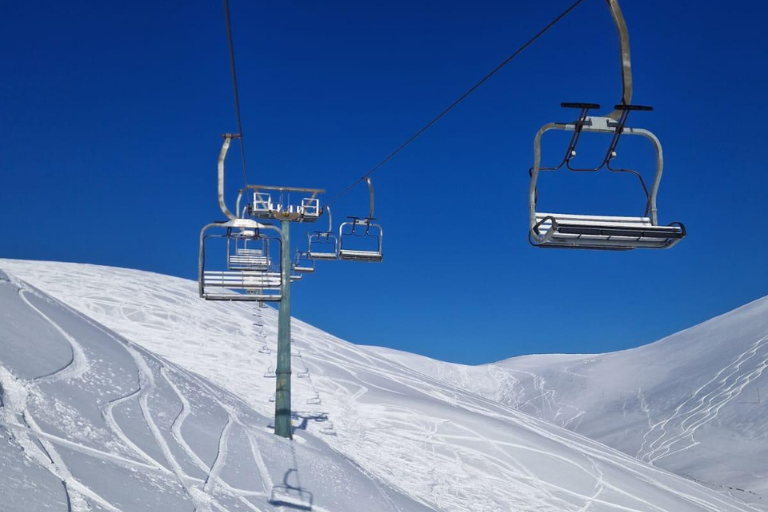
Blockhaus is a mountain in the Abruzzo Apennines, located within the Majella massif and inside the Majella National Park. Its name comes from a military fortification built in the 19th century during the Bourbon period. The area lies on a high-altitude plateau characterised by wide open spaces and a harsh, unspoilt natural environment with no permanent settlements. Blockhaus is best known as a gateway to the Majella and as a legendary stage finish of the Giro d’Italia, thanks to the long and selective climb that rises from the valley below.
Amantea - Cosenza
Villa d'Agri di Marsicovetere - Potenza
Pompei - Napoli
Roccaraso - Blockhaus
Grottammare - Fermo
Sasso Marconi - Corno alle Scale
Forte dei Marmi - Massa
La Spezia - Chiavari
Savona - Novi Ligure
Angera - Verbania
Aymavilles - Pila
Assago - Milano
Biasca (CH) - Carì (CH)
Tione di Trento - Andalo
Valdobbiadene - Pieve di Soligo
Agordo - Alleghe (Piani di Pezzè)
San Daniele del Friuli - Piancavallo
Roma - Roma